

Costs
Time of Use Tariffs: Where Battery Savings Actually Come From
Peak, off peak and shoulder rates explained, with the arithmetic that decides whether storage pays at your address.
Two things drive the cost of clean energy down. Better hardware squeezes more watts out of the same roof, and smarter software squeezes more value out of every watt you generate. Here is what is actually changing, and what it means for your bill.
All figures footnoted below. Last reviewed 24 July 2026.
Efficiency is the share of sunlight a panel turns into electricity. It matters to your wallet for a slightly indirect reason: a more efficient panel produces more power from the same roof, the same racking and the same day of labour.
Typical ranges in production, 2026[1]
The last bar is not comparable with the others. It is a single laboratory cell rather than a module you can buy, included to show the direction of travel.
TOPCon has become the mainstream cell design, reported at roughly 24 to 26 percent in commercial production against 20 to 22 percent for the older PERC panels it replaced. By the end of 2025 it accounted for the large majority of new cell manufacturing capacity worldwide.[1]
Heterojunction (HJT) reaches a similar efficiency band with a better temperature coefficient, meaning it loses less output on hot days, though it costs more. Back contact designs (IBC and ABC) move the wiring behind the cell and currently top the module efficiency tables at around 25 percent.[1]
Stacking a perovskite layer on silicon breaks the ceiling that limits any single junction cell. In July 2026 LONGi reported a certified 35.5 percent tandem cell, well beyond the 33.7 percent theoretical limit for single junction devices.[2]
Hardware decides how much energy you make. Software decides how much that energy is worth. On a time varying tariff the same kilowatt hour can be worth several times more at 6pm than at midday, and shifting it is a scheduling problem rather than a hardware problem.
A HEMS is the control layer sitting between your inverter, battery, meter, EV charger and major appliances. It decides when to store, when to use and when to export, using your tariff plus forecasts of solar output and household demand.[3] Many modern inverters and batteries include one, with varying degrees of sophistication.
Where a utility publishes day ahead or time of use pricing, control software can charge the battery when power is cheapest and discharge it into the expensive evening peak. This is where most of a battery's financial return comes from, so the quality of the software materially changes the payback.[3] See our guide to time of use tariffs.
A VPP aggregates thousands of home batteries so the grid can call on them at peak times, paying participants for the service. It can turn a battery from a pure cost saving into a small income stream, though it means giving an operator some control over your stored energy.[3]
Panel level monitoring flags a shaded, soiled or failed panel that would otherwise quietly cost you output for years. It is one of the few cases where paying a little more at installation reliably pays back, because undetected faults are invisible on a monthly bill.
Peak, off peak and shoulder rates explained, with the arithmetic that decides whether storage pays at your address.
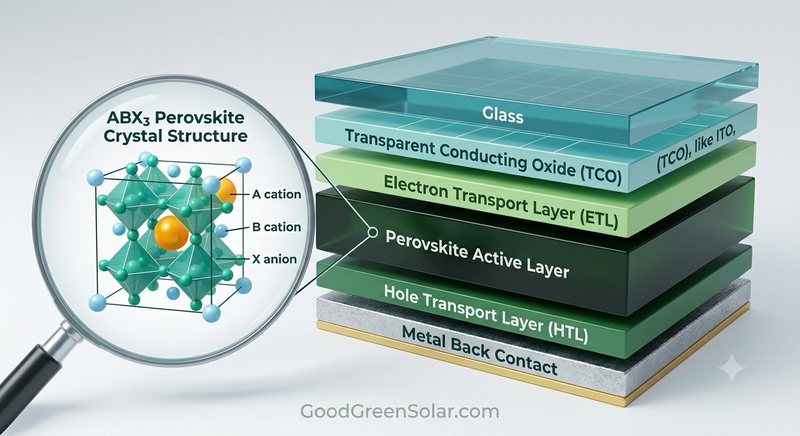
Tandem cells have passed 35 percent in the lab. What is real, what is still years away, and when it reaches your roof.
Built from salt rather than scarce metals. Why sodium-ion could make home and grid batteries dramatically cheaper.
Payback, tariff arbitrage and backup value, with an honest answer that depends entirely on your rates.
Renters and apartment dwellers can generate power too. The simplest entry point, and the rules to check first.

Manufacturing scale, efficiency gains and competition. The forces behind a 90 percent cost decline since 2010.
Laboratory cell records are measured on small area devices under controlled conditions and are not directly comparable with the rated efficiency of a commercial module.