The Perovskite Era: Higher Solar Efficiency, Lower Cost
For seventy years, silicon has done the heavy lifting in solar power. It's abundant, durable and well understood, but it is also bumping into a hard physical ceiling. A single-junction cell faces the Shockley–Queisser limit of about 33.7%, and silicon's practical ceiling is lower still, around 29 percent, with commercial panels sitting a good way below that.[1] To keep making solar cheaper, the industry needs a new trick. Right now, that trick is perovskite.
What is a perovskite cell?
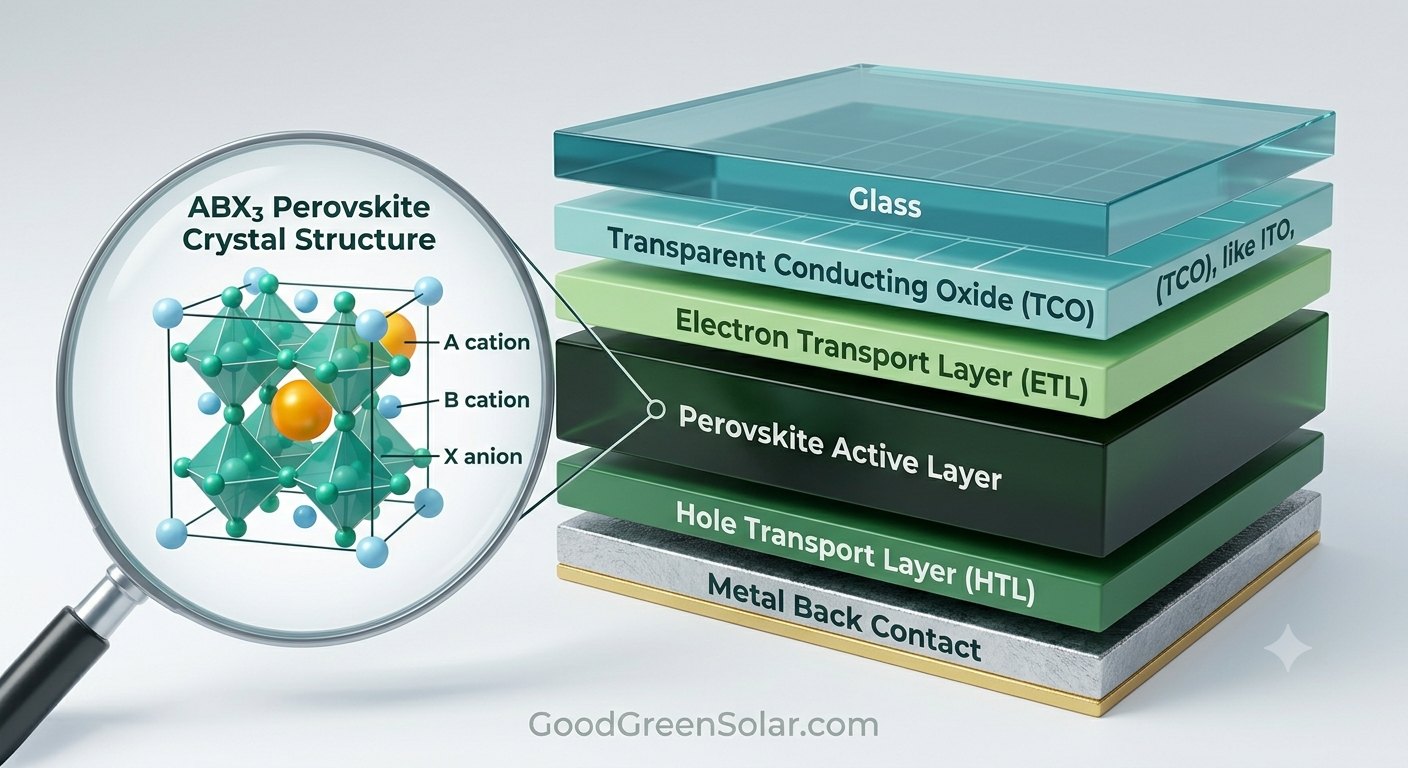
"Perovskite" refers to a family of materials that share a particular crystal structure. The versions used in solar can be made from cheap, common ingredients and deposited as a thin film, and can even be printed or coated onto a surface at low temperature. That's a big deal: silicon has to be purified and processed at high heat, which costs energy and money. A perovskite layer can, in principle, be produced far more cheaply.
The real breakthrough is not replacing silicon. It is stacking on top of it.
The magic is in the tandem
On its own, a perovskite cell isn't dramatically better than silicon, and durability has been its Achilles' heel. The exciting move is the tandem cell: a thin perovskite layer laid on top of a normal silicon cell. Each layer captures a different slice of the light spectrum. Perovskite grabs the high-energy blue and green light, silicon soaks up the red and infrared. Together they harvest far more of the sun's energy than either could alone.
In laboratories, tandem perovskite-silicon cells have blown past that ceiling. In July 2026 LONGi reported a 35.5% tandem cell certified by the European Solar Test Installation, a world record, and well above the theoretical limit for any single-junction cell. The most recent NREL-certified figure was 34.85% in April 2025.[1] Researchers put the theoretical ceiling for this tandem design as high as 43%.[1] That extra efficiency matters for your wallet in a subtle way: most of the cost of a solar project is not the cell itself. It is the roof labour, racking, wiring and permits. A more efficient panel produces more power from the same installation, spreading those fixed "soft costs" over more electricity.
So when can I buy one?
This is where honesty matters. Perovskites are moving fast, but two challenges stand between the lab and your roof:
- Durability. Early perovskites degraded quickly when exposed to heat, moisture and UV. Encapsulation and new formulations have improved lifespans enormously, but 25-year field reliability still has to be proven at scale.
- Manufacturing. Making a perfect small cell in a lab is very different from producing millions of large, uniform panels. Several companies are now scaling up tandem production lines.
The realistic picture: record cells are single, lab-scale devices measured under controlled conditions, a long way from a warrantied panel on a roof. Commercial tandem products are only beginning to appear, and volume will build over several years. If you're buying today, you'll almost certainly be getting high quality silicon, and that is perfectly fine. If you're weighing whether to wait, don't hold your breath for a specific launch date; buy when the numbers work for you.
What it means for affordability
The perovskite story is really a continuation of solar's long-running trend: more watts, lower cost per watt. Even before tandems are everywhere, their arrival keeps competitive pressure on silicon prices. For households, the takeaway is simple. Solar is not going to get more expensive. If anything, each new panel generation makes the economics a little better.
Sources & notes
- Tandem efficiency records. LONGi's 35.5% crystalline silicon–perovskite tandem cell, certified by the European Solar Test Installation (ESTI) and announced 14 July 2026; previous NREL-certified record of 34.85% (18 April 2025); Shockley–Queisser single-junction limit of 33.7% and a theoretical tandem ceiling around 43%. pv-magazine.com, LONGi 35.5% tandem record · NREL best research-cell efficiency chart ↩
Cell-efficiency records are lab measurements on small-area devices and are not directly comparable to the rated efficiency of a commercial module. Last reviewed 24 July 2026.